Integrations & Automations

Chatbots and AI automation, shipped to production — not demos

We build RAG chatbots, tool-using agents, and the workflow plumbing behind them. Claude Opus, GPT-5, LangGraph, vector DBs — wired into your stack with evals, guardrails, and monitoring.

Slash CommandsRole ManagementCustom IntegrationsHosted 24/7

Most AI projects stall between the prototype and the production rollout. We do the production rollout — the retrieval pipeline, the tool calls, the evals, the cost controls, the operator dashboard.

Production AI, not demos

Retrieval, tool use, evals, monitoring — wired in from day one, not bolted on after launch.

Connected to your stack

Your CRM, your database, your APIs, your Slack — agents that actually do work, not chat about it.

Cost and latency aware

Right model for the right step. Caching, routing, and batched calls keep bills sane and responses fast.
AI chatbots that know your business

We build RAG chatbots trained on your real content — docs, knowledge base, product catalog, ticket history — so answers stay grounded and citable instead of hallucinated. The retrieval layer uses a vector DB (Pinecone, Qdrant, or pgvector) with hybrid search and reranking, and we tune chunking and embeddings against an eval set so quality is measurable, not vibes-based. Every chatbot ships with the boring-but-critical parts: an embeddable widget, lead capture into your CRM, human-handoff, transcript storage, and dashboards for conversation volume, deflection rate, and unanswered questions. Multi-language out of the box via the model — no second pipeline to maintain.

RAG on your content

Docs, knowledge base, PDFs, and product data indexed with hybrid search and reranking — grounded answers with source citations.

Lead capture

Qualified leads pushed straight into HubSpot, Salesforce, or your CRM with the conversation context attached.

Multi-language

Detect and respond in the visitor's language — one model, no separate per-locale pipelines to maintain.

Embed anywhere

Drop-in JS widget, iframe, or REST API — works on Webflow, WordPress, Next.js, or a native app.

Transcripts and analytics

Every conversation logged, searchable, and graded — deflection rate, unanswered topics, CSAT, and cost per session.

Custom AI agents — tool use, memory, real workflows

Chatbots answer questions. Agents do work. We build multi-step agents that plan, call tools (your REST APIs, internal services, databases, browsers), persist memory across sessions, and recover when a tool fails. Built on LangGraph or the Anthropic SDK directly, depending on how much control you need over the loop. The difference between a flashy demo and an agent your team trusts is evals and observability. We define a golden task set, score every run against it, and ship monitoring (LangSmith, Helicone, Langfuse) so regressions are caught before users see them. Guardrails — input validation, output schemas, allowlists, max-step budgets — keep the loop bounded.

Tool use (REST, internal APIs)

Agents call your services with proper auth, retries, and schema validation — not free-form curl in a sandbox.

Memory and state

Short-term scratchpads plus long-term memory in Postgres or a vector store — agents that remember context across sessions.

Multi-step workflows

LangGraph or hand-rolled state machines for branching logic, parallel tool calls, and human-in-the-loop checkpoints.

Evals and guardrails

Golden task sets, output schemas, allowlists, and step budgets — measurable quality before you ship, not after.

Monitoring (LangSmith, Helicone)

Trace every call, track latency, token spend, and tool-error rates — debug agents the same way you debug a service.

Automating the work humans shouldn't do

Zapier and Make are fine until the logic gets specific or the per-task bill gets silly. We build custom Node.js workflows or self-host n8n on your infrastructure — same drag-and-drop UX, no per-execution pricing, full access to logs, retries, and queues. Webhook-driven, idempotent, observable. This is the layer that quietly runs the business — social posts scheduled across 11+ platforms, email sequences gated on CRM events, scraped data normalized into your warehouse, Slack and Discord bots that route requests to the right team. The boring infrastructure that frees up days of human work per week.

Custom workflows (Node.js / n8n)

Self-hosted, no per-task fees, full access to logs and retries — built around your actual business logic.

Marketing automation (email, social)

Event-driven email sequences and scheduled social posts across LinkedIn, X, IG, FB, Reddit, Bluesky, and more.

API integration (any-to-any)

OAuth, retries, idempotency keys, and webhook signing — connectors built to survive partner outages.

Web scraping and data extraction

Playwright, residential proxies, LLM-assisted parsing for unstructured pages — clean rows into your DB or warehouse.

Slack / Discord / Telegram bots

Slash commands, modals, role gating, payments — internal tools and community automation that fit your stack.

CRM extensions (Salesforce / HubSpot / Dynamics)

Custom objects, Apex/Lightning components, server-side flows, and AI enrichment baked into the records your team already uses.

Portfolio

AI work we've shipped

A sample of production AI and automation work — agents at YC startups, multi-platform social publishers with AI content generation, and Discord-first community tools.

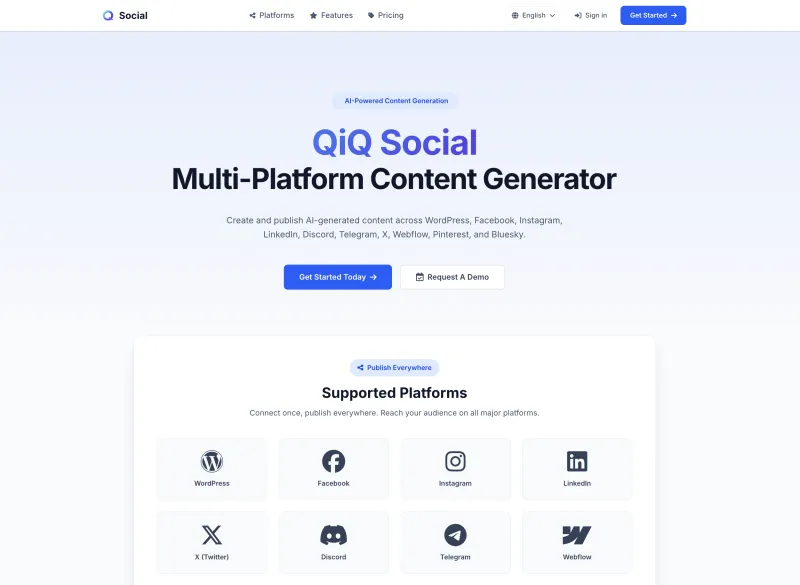
QiQ Social
QiQ Social logo

QiQ Social

Designed and built the AI content engine and OAuth-driven publishing layer across 11+ social platforms — LinkedIn, X, Discord, Telegram, Pinterest, Bluesky, FB, IG, Webflow, WordPress, Reddit.

Visit site
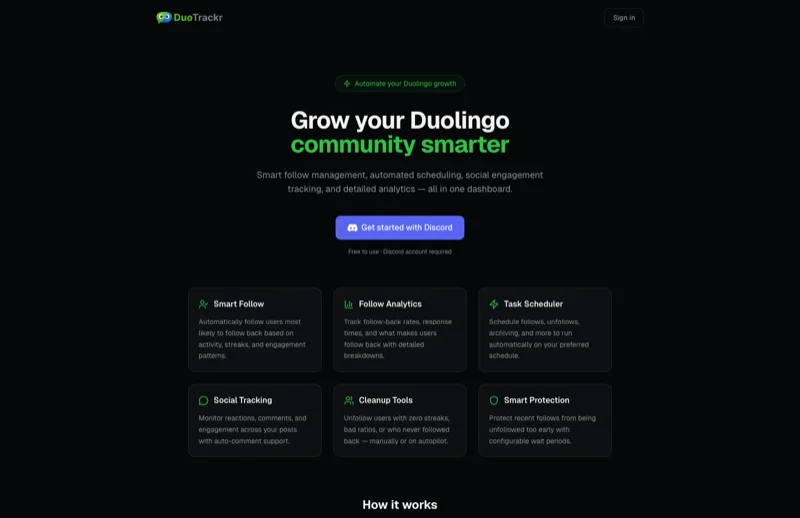
DuoTrackr
DuoTrackr logo

DuoTrackr

Discord-first community growth toolkit with a bot-driven action layer, automated scheduling, follow management, and analytics — built end-to-end and live with a growing user base.

Visit site

Yours could be the next AI shipped on this page.

Custom chatbot, multi-step agent, or LLM-powered workflow — send the brief and you'll have a plan and a fixed quote inside 24 hours.

Get a Free Estimate

Models, frameworks, infrastructure

We pick the model that fits the step — frontier models for reasoning and tool use, smaller or open-source models for cheap classification and bulk work. Routing, prompt caching, and batching keep latency and spend predictable. Self-hosting is on the table when data residency or unit economics demand it.

Claude (Anthropic)

Opus for hard reasoning and multi-step agents, Sonnet for general production work, Haiku for cheap high-volume calls.

GPT (OpenAI)

GPT-5 and GPT-4.x for tool use, structured outputs, and the Realtime API for voice — picked per step on cost and latency.

LangChain / LangGraph

Used where graph state and human-in-the-loop matter; raw SDK when we want full control of the loop.

Vector DBs (Pinecone, Qdrant, pgvector)

Pinecone for managed simplicity, Qdrant for self-host, pgvector when your data already lives in Postgres.

Self-host (Llama, Mistral)

Llama 3 and Mistral on vLLM or TGI for data-residency, fine-tuning, or cost reasons — only when it actually pays off.

Eval frameworks

LangSmith, Promptfoo, Braintrust, and custom golden sets — quality measured per release, not assumed.

FAQ

Common questions

How do you keep an AI chatbot from hallucinating about our product?
Two things: retrieval-augmented generation grounded in your source content with citations, and an eval set you sign off on. We index your docs, knowledge base, and tickets into a vector DB with hybrid search and reranking, then run a graded test suite against every model and prompt change. If a regression slips past the bar, the release doesn't ship.
Claude vs GPT — which model do you use?
Both, usually in the same system. Claude Opus and Sonnet are strong for multi-step tool use, careful reasoning, and long-context work. GPT-5 and GPT-4.x are strong for structured outputs and the Realtime API for voice. We route per step based on quality, latency, and cost — and benchmark on your eval set, not someone else's leaderboard.
Will an AI agent actually work, or is it just a flashy demo?
The difference is evals, guardrails, and monitoring. We define a golden task set up front, score every agent run against it, enforce output schemas and tool allowlists, cap step budgets, and ship LangSmith or Helicone traces so the team can debug it like any other service. That's how an agent earns trust instead of just trending on X.
What does this cost to run in production?
Depends on traffic, model mix, and retrieval volume. A typical RAG chatbot runs a few cents per conversation with prompt caching and Haiku/Sonnet routing; agents with heavy tool use can run higher. We build a cost dashboard from day one and optimize with model routing, prompt caching, batching, and self-hosted open models where the math works.
Do you self-host, or use APIs?
Whatever the use case demands. Most projects start on Anthropic and OpenAI APIs because the quality-to-cost ratio is strong and ops are simple. For data-residency, high-volume classification, or fine-tuning needs, we self-host Llama 3 or Mistral on vLLM or TGI behind the same interface.
Ready when you are

Put AI somewhere it actually moves the needle

Tell us the workflow you wish ran itself. We'll come back with a scoped plan — model choice, retrieval design, evals, monitoring, and a real ship date.